The Party Problem That Broke Mathematics
Picture this: You're throwing a party. You've invited 45 people. Some are friends, some are strangers. As the evening unfolds, you notice something curious happening in the corners of your living room...
Little do you know, you've just stumbled into one of mathematics' most beautiful and frustrating mysteries, a problem so deceptively simple that it has stumped the world's greatest minds for nearly a century.
This isn't just a party game. It's a window into the deep structure of randomness, order, and the universe itself.
The Question That Started It All
Here's the puzzle: How many people must you invite to guarantee that either 5 of them all know each other, or 5 of them are complete strangers?
Sounds like a fun icebreaker, right? Wrong. This innocent question leads us straight into the heart of Ramsey theory, and to a number we've been chasing since 1930.
Frank P. Ramsey, a brilliant British mathematician and philosopher, first posed this problem while studying logic. He wasn't even working on graph theory, he was exploring the foundations of knowledge itself. Yet this simple question about parties and friendships would become one of combinatorics' most enduring mysteries.
Why This Matters (Beyond the Party)
Think about it: In any group of people, complete chaos seems possible. You could have a room full of people where relationships are perfectly random: some friends, some strangers, no pattern at all.
But Ramsey's insight was profound: Complete randomness is impossible. No matter how hard you try to avoid it, structure will emerge. Order is inevitable.
This isn't just mathematics, it's a statement about reality itself. In a universe that seems chaotic, patterns are forced to appear. The question is: when?
The Graph Theory Translation
Let's translate this into the language mathematicians use:
- Each person becomes a node (a point)
- If two people know each other, we draw a red edge connecting them
- If they're strangers, we draw a blue edge
Now the question becomes: What's the smallest number $n$ such that every way of coloring the connections (red or blue) must create either:
- A group of 5 people all connected by red edges (everyone knows everyone), or
- A group of 5 people all connected by blue edges (everyone is a stranger to everyone else)
This number is called $R(5,5)$, the Ramsey number for 5.
And here's the kicker: We don't know what it is.
For many years, all we knew was that it lay somewhere between 43 and 48.
$$43 \leq R(5,5) \leq 48$$
But in September 2024, a new computational breakthrough improved the upper bound. Vigleik Angeltveit and Brendan McKay proved that $R(5,5) \le 46$, tightening the range even further.
You can read their paper here: https://arxiv.org/abs/2409.15709
So the current best known range is:
$$43 \leq R(5,5) \leq 46$$
After nearly 100 years of work, we've narrowed it down to just 4 possible values. And we still can't say which one.
Building Intuition: The Smaller Cases
Let's start with something we can actually solve to build our intuition.
The Case of 3 People: $R(3,3) = 6$
With just 6 people at your party, you're guaranteed to have either 3 mutual friends or 3 mutual strangers. You can prove this with a pencil and paper, it's that elegant.
Try it yourself: Draw 6 dots (people). Try to connect them with red or blue lines (friendships or stranger-ships) in a way that avoids having either 3 all-red connections or 3 all-blue connections. You'll find it's impossible.
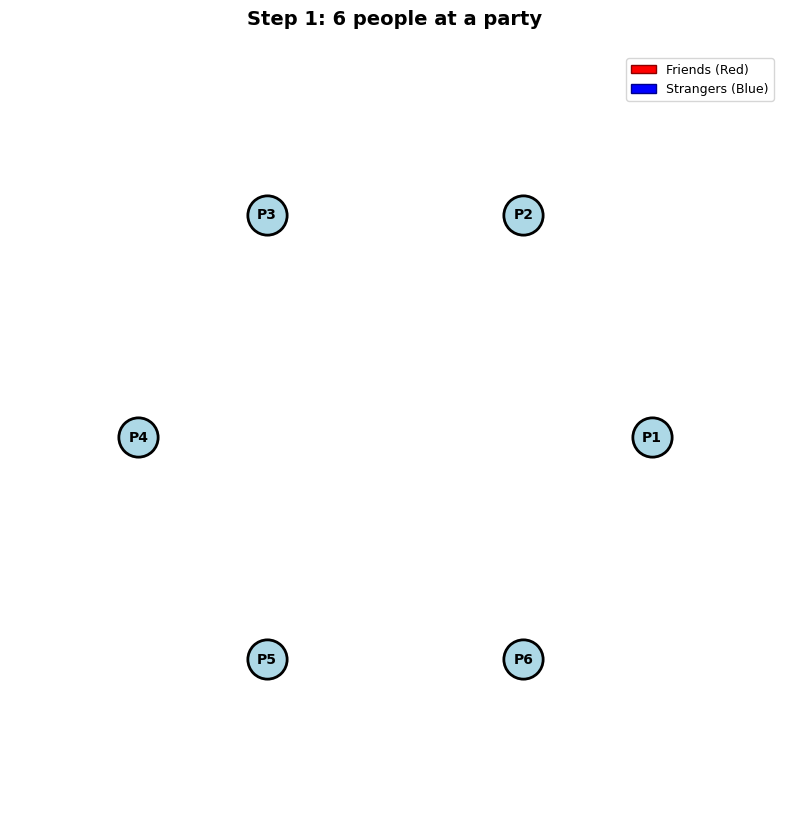
An animated demonstration of $R(3,3) = 6$. No matter how you color the edges red or blue, you'll always find either a red triangle (3 mutual friends) or a blue triangle (3 mutual strangers). Click the image to pause or resume the animation.
This elegant result is the foundation. It's simple enough to verify by hand, yet it contains the seed of the deeper mystery.
The Case of 4 People: $R(4,4) = 18$
Now things get interesting. To guarantee either 4 mutual friends or 4 mutual strangers, you need 18 people. Notice how the number jumped? That's the combinatorial explosion beginning.
This one took serious mathematical effort to prove. No more pencil-and-paper solutions.
The Case of 5 People: The Mystery
For 5 people? We're still stuck.
- With 42 people, you can arrange relationships to avoid both patterns.
- With 46 people, it is now proven to be impossible to avoid them.
- Between 43 and 45? Nobody knows.
Somewhere in that tiny window of 3 numbers, the boundary between possibility and impossibility hides. And we've been searching for it for decades.
The Combinatorial Explosion: Why This Is So Hard
Here's where the problem reveals its true nature. For a party with $n$ people, the number of possible ways to color the relationships is:
$$2^{\frac{n(n-1)}{2}}$$
For 43 people, that's:
$$2^{903}$$
$2^{903}$ is larger than the number of atoms in the observable universe.
Brute force is not an option. The search space is simply too vast.
This is why mathematicians need cleverness, not just computation. This is why the problem persists.
Why There’s No Closed-Form Solution
In mathematics, a closed-form solution means an explicit formula, a finite expression built from familiar operations such as addition, multiplication, powers, or logarithms, that directly computes the answer from $k$.
For Ramsey numbers, no such expression is known.
Closed-form formulas typically arise when strong algebraic structure is present. Ramsey numbers, by contrast, are defined by extremal combinatorial behavior, the most adversarial way to avoid structure inside an enormous search space.
They are thresholds: the precise point at which avoidance becomes impossible.
Even for general $k$, we know only broad exponential bounds. Each exact value requires its own argument.
The Deeper Truth: Randomness Forces Order
Complete randomness is a mathematical impossibility.
No matter how chaotic you try to make a system, structure will emerge.
Ramsey theory makes this precise. It does not assume order. It proves that order is unavoidable once a system becomes large enough. You can color edges randomly. You can try to avoid patterns deliberately. You can design the most adversarial configuration imaginable. Eventually, the combinatorics overpower you.
This is not about probability. It is not about “likely.” It is about inevitability. Beyond a certain threshold, disorder cannot sustain itself.
In sufficiently large systems, patterns are forced. Structure is not an accident. It is a consequence of scale.
And that is the quiet power of Ramsey theory: chaos has limits.
Why This Problem Is Beautiful
This problem is beautiful precisely because it's so simple to state and so impossible to solve.
It seems almost disarmingly simple. But it hides astronomical combinatorics and computational complexity.
And still, we don't know whether the answer is 43, 44, 45, or 46.
The search continues. The mystery persists. And somewhere between 43 and 46, mathematics is waiting.